Khanderao on SOA-ESB-BPM & JAVA

Thursday, November 12, 2009

Google Android in an Integrated Communication Device As a Home / Kitchen Unit

My blog on this ...

http://texploration.wordpress.com/2009/11/13/google-android-in-action-in-home-device-by-vega-icd/

Labels:

Add to Technorati Favorites

Save This Page on del.icio.us

Wednesday, November 11, 2009

Googlers announced "Go" Programming language

googlers announced a new programming language "Go" w


Go is being advertised as Fast (to compile), Safe(pointers without pointer maths), Concurrent (lightweight process communication) and Cool (dynamic language but has the speed and safety of a static language) and open source...   disclaimer: I am yet to validate these claims...

Here is a video clip introducing the Go

http://www.youtube.com/watch?v=wwoWei-GAPo

Googlers:
Robert Griesemer
Kenneth Thompson
Rob Pike
Russ Cox
Ian Lance Taylor

Labels:

Add to Technorati Favorites

Save This Page on del.icio.us

Thursday, October 22, 2009

Increased Momentum to Hybrid Cloud

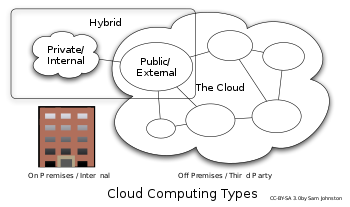
Hybrid Cloud as depicted in the following diagram is a middle path for enterprises for taking advantage of the public clouds as well as addressing the security and ownership concerns of mission critical as well as sensitive data.


Recently at OOW 2009 is SFO, Mark Benioff, CEO of Salesforce, showed agreement to the Hybrid approch.  Both Dell and SaleForce determined on this Hybrid approach.

Labels: ,

Add to Technorati Favorites

Save This Page on del.icio.us

Monday, October 19, 2009

Does Enterprise Apps on a Box make sense?

In OOW 2009, Larry Ellison presented a powerful case of DB on a Box Machine. He demonstrated Exadata2 for almost more than half of his presentation time. It is a good story to make customer up and running quickly and saving from chasing different vendors. However, he presented it in the context of Database. Wouldn't the same model make sense for Apps too? It's is kind of different than the current momentum to SaaS and Cloud. But installing, configuring, tuning and setting up enterprise Apps is a time consuming process involving multiple vendors and skills. If that can be reduced by this Apps on A Box model, would it be better?

Labels: ,

Add to Technorati Favorites

Save This Page on del.icio.us

Wednesday, October 14, 2009

Larry J. Ellison at Oracle Open World 2009

(This is my near real-time blog. Most of the content was keyed in real time and later was little bit polished .)

Wednesday was the Larry's keynote day. Today at 2:45pm it was scheduled in the Mascone center where the Oracle Open world is being held. In the beginning, Charles Philip introduced the Diamond sponsor of the event, Infosys and its CEO Mr. S. Gopalkrishnan. His speech was focused on IT led innovation. It had a lot of good content but the presentation needed to be improved. Particularly such a large audience expects some charisma, some laughter and some real life incidents connecting to the crowd. Anyway, after the Infosys' CEO's speech on Innovation, Charlse Philip invited Larry. In his typical black sports jacket and black (crew style) sweat/T shirt, Larry appeared on the stage. Right in the beginning, LJE mentioned the topics he was planning to cover starting with Linux to Fusion Apps. Here are some of the snippets from his presentation.

It seems that flow of his presentation was from OS to dedicated box to monitoring to Fusion Apps.

So LJE started with Linux. Remember 2 years back at OOW he had introduced Oracle Linux and last year he had introduced VM. This year he unified the vision with his comment. In LJE's view, the Virtual VM and OS should blend together for easier to deploy, patch etc. Oracle VM would also support other OSs (like Windows)

Then Larry moved on to Exadata Version 2
Running Oracle enterprise Linux, Sun Oracle Database Machine . He specifically mentioned that this machine is different than the Spark based machine, demonstrated on Sunday, which is 16 times faster than similar from IBM. The customers are getting performance improvement with 10s of times not just in 10s of percentages. Exadata2 is very first database machine aimed for high performance OLTP and not for warehousing like others.
Exadata2 does random IO very rapidly. It is fastest and fault tolerant and consuming less power. 1million disk i/os per sec. Despite 72 racks, IBMS machine is not fault tolerant but very costly. For same money, Exadata is 4 times faster.

Somewhere here we saw "Kalifornia"s governator Mr. Arnold appearing on the stage! He covered a lot on innovation and technology. He mentioned how he could do so much in movies because of the technology. He then moved to clean tech and environment. The only joke that he could create a good laughter was about hands-free cell phone and his wife Maria getting three times caught breaking the hands-free-cellphone law. Anyway, he ended with praising role of Oracle and Sun in innovation, business and employment to California.


Afterward, Larry launched a crusade on IBM with the performance edge of the Exadata. During the course, he also elaborated the key contributors in improving the performance. He emphasized that it is faster than fancy-specialized In-Memory DBs. It is faster because of Grid computing, compression the data, faster movement of data, and with the usage of fast flash drives.
Another advantage of Exadata2 that he mentioned was it has simplified deployment because everything pre-cofigured.
Costs 110,000 - 350,000 - 600,000 ... Start small and grow.

In Summary, Exadata is positioned as:
The Fastest for Warehousing and OLTP, best cost/performance and Fault tolerant & scalable.

This is where Larry offered his $10 million challenge to anyone including IBM to run any apps on similar IBM box with more than half the speed that of Exadata! Read again $10 million!!

Then LJE moved on to monitoring but introduced beyond just monitoring. He introduced the concept of central Global Configuration DB that can be used for Proactive problem prevention. It can be used for Recommends patches, health checks etc. Such system would proactively notify customers based on their configuration about problems and solutions. Then help in problem resolution with automated download, validation and merge patching.

He also elaborated the usage of Business Service Metrics in EM for Detect underlying technical infrastructure failures and then use Correlation Engine to further diagnose the issue. Richard demonstrated the real time problem detection, patching and merging.

Larry's final presentation was the latest and greatest introduction to Fusion Applications. he high-lighted that Fusion apps are:
1. SaaS ready / Cloud Ready
2. Service Oriented Architecture. Because of SOA, it can be easily connected to other apps.
3. Fusion Apps: Replacement Applications and new apps are add on to Apps Unlimited!

This last aspect is a great story to motivate existing customers to upgrade or selectively adapt.

Anyway, during his presentation, Larry mentioned following applications: Talent Management., DOO, Incentive Compensation, Territory management, GRC, etc ... all these apps I provided consultancy to!!!!

While covering details, Larry emphasis following design Principals of Fusion Apps.
1. Standards based middle-ware
2. Embedded business intelligence
3. Modern and consistent UI with integrated collaboration
4. SOA
5. SaaS
Now pause at the third bullet:SOA! Just remember that is the key of the co-exist with apps-unlimited or with any other apps. Isn't it the most important aspect of the Fusion Apps? Oh, I was probably over-emphasizing the area where I played role in SOA-BPM!

Larry then invited Steve Miranda for demonstration of Fusion Apps(I like working with him. A very nice-pleasant personality and good leader). Chris Leon joined Steve for the demos. They demonstrated two scenarios. Both demonstrated a very new way of building apps. Fusion Apps uses BI natively. It also provides real-time collaboration. And I am proud to be one of the key contributor in SOAfying the Fusion Apps!

The overall show was almost 2hrs 15mins and it had engaged all the crowd. Larry does a great job especially without slides. I was hoping some more fire-shots but I guess this was enough. Anyway, Oracle already announced more than half a dozen new releases this week. That itself is overwhelming.

Typically keynote speeches are high on messages and less on details. The audience was looking for a direction and new launches. That way, Fusion Apps and EM based auto patching were the new launches. The Linux-VM and Exadata was the direction or continuation. These two in general and later in specifically suitable for setting a stage for Sun merger. Linux and VM direction was a message of continuity and consistency with previous open worlds.

Analysts also analyze Larry's speeches for his positioning with respect to the competitors. Though RedHat (Linux), Vmware(VM), SAP (Fusion Apps) are direct competitors in those respective markets, Larry did not spend time on those but focused on IBM. It was surprising that he spared SAP too. Isn't it interesting? Is SAP out of picture? Another observation, he did not comment much on cloud computing. However, he respectfully added SaaS in the context of Fusion Apps. In my opinion, such ommissions and commissions give a sense of direction for Oracle. Does it? Especially on the backdrop in Larry's interview a couple of weeks back where he ridiculed the hype of cloud-computing and then affirmed the presence of the cloud-computing. In the contrast, it was missing from today's keynote but SaaS and Linux-VM was added on top of Exadata. BTW I also noticed that Larry quickly adapts to the changes in the environment. So it won't be surprising that he would change his pitch if the environment changes.

Labels: , , , , ,

Add to Technorati Favorites

Save This Page on del.icio.us

Monday, October 12, 2009

Talking At OOW 2009 Today on SOA Suite Best Practices Based on Development Experience of Fusion Apps

Session Information

ID#: S308799
Title: Oracle SOA Suite 11g Best Practices Based on Oracle Fusion Applications Development Experiences
Date: 12-OCT-09
Time: 17:30-18:30
Venue: Hilton Hotel
Room: Yosemite B

Labels: , , ,

Add to Technorati Favorites

Save This Page on del.icio.us

Tuesday, September 22, 2009

Very Live Interview of LJE with a great humour and punchlines:

Its seems that great CEOs had a good time. Here is a glimpse of the witty interactions...

On Cloud Computing

"Everyone looks around and is like, 'Yah! Like everything is in the cloud,' " mocked Ellison. "My objection is it's absurdity--it's nonsense ... What are you talking about? It's not water vapor. It's a computer attached to a network!"

Again on Cloud Computing
"Cloud computing isn't the future--it's the present and the past of computing,"

This is the best comment on life:
"I think life is a series of acts of discovery," Ellison mused. "We're all interested in discovering our own limits."

Labels:

Add to Technorati Favorites

Save This Page on del.icio.us

Wednesday, September 16, 2009

SOA on Cloud

In today's world of Cloud computing, I would like to make a case for SOA on Cloud. It make sense for providing an agile and scalable infrastructure. SOA on Cloud would bring the setup cost of the customers down. Recently I had a discussions with a large consulting company engaged in providing SOA consultancy and Syetem integration to large enterprises. The executives really liked the idea of SOA on Cloud. That would immediately bring their cost down. In their opinion, at each client they spend 2-3 weeks in getting environment procured, set up etc before they could start SOA setup. With SOA on the cloud, they can immediately avoid all the setup time and start doing the real work. Obviously the saved time is a saving on billable hours.

Labels: ,

Add to Technorati Favorites

Save This Page on del.icio.us

Tuesday, September 15, 2009

Google FastFlip .. My quick take on it..

http://texploration.wordpress.com/2009/09/15/first-look-at-fastflip-flip-or-flop/

Labels:

Add to Technorati Favorites

Save This Page on del.icio.us

Flaws in Using BPEL to implement Orchestration Engine than Using BPEl to Orchestrate a Process Flow

BPEL provides a Web Service Orchestration language. Like any basic programming language, it has some constructs for declaring variables, switching, looping, sequencing or parallel branching, etc. Due to this construct, some times I came across implementation where BPEL is used as a programming language implementing an Orchestration Engine itself than an orchestration language. In this case, the flow sequence is captured as a model in database tables and then BPEL process is an engine which uses the model in the tables to get the next activity. So it kind of "implementing an orchestration" engine in BPEL rather than Orchestrating in BPEL. Isn't it cool? or Are there any issues? Yes, in prima-facie it looks like cool, creative and innovative. However, you would need to think about what BPEL orchestration is, how would compensation work? how about fault handling? how can you view the process itself, whether you would be able to meaningfully monitor the process? In most of the scenarios, the answers to these questions would steer you away from using BPEL as a programming language

Labels:

Add to Technorati Favorites

Save This Page on del.icio.us

Thursday, September 10, 2009

IBM, watch out, we are coming to win it !


WSJ Advertisement:

Add to Technorati Favorites

Save This Page on del.icio.us

Wednesday, September 09, 2009

Speaking at Oracle OpenWold 2009

I will be speaking at OOW 2009 on Oct 12th. The topic will be:
Oracle SOA Suite 11g Best Practices Based on Oracle Fusion Applications Development Experiences

Labels: , , , ,

Add to Technorati Favorites

Save This Page on del.icio.us

Wednesday, August 19, 2009

ITPIO Launched : News covered in the Economic Times of India

http://economictimes.indiatimes.com/articleshow/4907390.cms

Association for Indian origin IT professionals launched in US
18 Aug 2009, 1908 hrs IST, PTI

Print EMail Discuss Share Save Comment Text:
SILICON VALLEY: With an objective to bring Indian origin IT professionals at one platform and give them a common voice, an association of IT
professionals has been launched here.

"ITPIO gives an opportunity to all IT professionals and other professionals as well to communicate with each other," Sri Chawla, CEO of US Microtech and a philanthropist in the Silicon Valley said in his inaugural address.

The first chapter of the Association of IT Professionals of Indian Origin (ITPO) was launched in the Silicon Valley on August 15 - India's Independence Day.

"IT professionals from India are well known and perceived for their skills, professionalism and success - yet they do not have an organisation representing their professional interest," Khanderao Kand, founder of ITPIO said.

"ITPIO is a great platform for everyone from entry level to C level with an objective to promote the professional leadership to make an Indian Imprint on the progress of world," Kand added.

Speaking on the difficult times being faced by IT industry
, well known CEO and Entrepreneur Coach Dr Prasad Kaipa in his key note address said, "Turbulent times are the appropriate times for positive deviance, for stretching, risk taking and this will show up us as leaders."

Primarily focusing on fostering the leadership and personal development of IT professionals of Indian Origin, ITPIO has also initiated chapters in Denver,Washington, Seattle Hyderabad and Bangalore.

Add to Technorati Favorites

Save This Page on del.icio.us

Friday, August 07, 2009

IT Professionals of Indian Origin (ITPIO) hosts Dr. Kaipa's Talk on "Career and Self Development in Current Economically Turbulent Times”

India’s Independence Day

IT Professionals of Indian Origin (ITPIO) Bay Area Chapter, Inaugural Session
( http://www.it-pio.org/Web/events.html )
Saturday, August 15, 2009, 5:00 pm to 7:15pm,
Free Entry

Keynote Speech

“Career and Self Development in Current Economically Turbulent Times"

By Dr. Prasad Kaipa

At

HP Oak Room, 19111 Pruneridge Ave, Bldg 48 Cupertino, California 95014

Dr. Prasad Kaipa is a strategic advisor, management guru and a CEO coach to CEOs, board members and senior executives. Since 1990, Dr. Kaipa has advised CEOs and coached Executive Teams in the areas of Innovation, Business Transformation, Decision Making, Strategic Thinking and Personal Mastery. Some of his clients include HP, CISCO, Disney, Adobe, Apple, Xerox, Boeing, Mastek, BAE Systems Mastek and Navteq. Dr. Kaipa is a visiting faculty at the Indian School of Business and part-time faculty at the Saybrook Graduate School, San Francisco, CA. For more information: http://prasadkaipa.com

Program

* Indian Cultural Program (Patriotic Songs)
* Speed Networking Game (Bring business cards)
* Presentation/Inauguration of ITPIO Bay Area
* Keynote Speech by Dr. Kaipa
* Recitation of National Anthems of India and USA

ITPIO is a networking association of IT Professionals of Indian Origin. ITPIO aims to bring professionals in the fields of hardware and software together for their career and personal development while contributing back to the IT profession and community. ITPIO aspires to represent the interests of Indian IT Professionals in the policies and issues related to Information Technology.

For more information:
Email: KHANDERAO at YAHOO dot COM or ITPIO at YAHOO dot COM

SNACKS for Early Arrivals starting from 4:45 pm.

Add to Technorati Favorites

Save This Page on del.icio.us

Thursday, July 23, 2009

AS11 SOA Tips: Configuring Component (Process) level properties

Oracle's SOA Suite AS11 is based on SCA (Service Component Architecture). Hence the configuration of process level properties is also done as per SCA standard. To be specifically as component properties in composite.xml

Here is an example:


For details refer to FMW SOA Documentation Appendix C

Why is it important?
The Component Properties can be configured in the production environment via Enterprise Manager and they can be accessible to the running component or component container (or service engine like BPEL)

Labels: , ,

Add to Technorati Favorites

Save This Page on del.icio.us

Thursday, July 16, 2009

SOATips AS11 Moving SOA Projects Prom Dev-test To ProductionP

SOA projects often embed physical addresses of various servers hosting wsdls, xsd s etc. For example, a SOA composite may invoke another service hosted on other box hosting a test environment and may refer xsds on the box. The physical address could be in the composite.xml where bindings and imports could be pointing to wsdls on target servers (which may change)
For example, a reference in composite.xml would be like following:


Whenever the SOA project needs to be deployed on a production environment, these references to test environment needs to be replaced by the appropriate references in the production environment.

This replacement can be done during the deployment time using Configuration Plan. It understands the composite/ wsdl/xsd constructs that may have the concrete address embedded within e.g.


Config plan is a xml file that contains information related to replacing the appropriate strings. The config plan can be generated from composite by right clicking on the composite.xml from jdev.


The plan should associated to soa composite during the deployment time.

Labels: ,

Add to Technorati Favorites

Save This Page on del.icio.us

Wednesday, July 15, 2009

AS11 SOA : Tracing events using event logger

If you are publishing events in AS11 and would like to trace it : A quick check to see whether event has been published or not would be using event logger.

http://:port/soa-infra/events/edn-db-log

Of course, you can also use Enterprise Manager (em) to trace the event. There are multiple ways to trace them in EM.

1. Through instance tracking on the subscribing composite,
2. Business Events page in EM ( Right click on soa-infra -> select Business Events)
3. Looking into log files ( once again via EM)

Labels: , ,

Add to Technorati Favorites

Save This Page on del.icio.us

Tuesday, July 07, 2009

Event vs Services to initiate a BPEL process in AS11

Since As11 supports both events and services to initiate a SOA composite ( may be having a BPEL process within it), there is always a question around when to use events and when to use service invocation to start the process.

The decision can be based on the following understanding of the events and service patterns.

Events
  • Events are suitable for a decoupled integration.
  • Events are one way messaging (no request response pattern and correlation)
  • The publisher does not know about the subscribers (there might not be subscribers too)
  • The publisher is not blocked for the execution of the subscriptions
  • Events support 1:n fan out (multiple subscribers for the same event)
Service invocations
  • Service invocation is a tight integrations with the service provider
  • Service invocation supports request response patterns (sync or async)
  • Synchronous service invocation is blocked till the execution of the service completes.
  • Async Request response pattern is often supported via WS-adderessing and correlation

Labels: , , , , ,

Add to Technorati Favorites

Save This Page on del.icio.us

Thursday, July 02, 2009

Started another blog focusing on Software Development Management

Labels:

Add to Technorati Favorites

Save This Page on del.icio.us

Another post on Google Wave: Applications

Just posted in my Texploration blog.
http://texploration.wordpress.com/2009/07/02/applications-of-google-wave/

Labels:

Add to Technorati Favorites

Save This Page on del.icio.us

Quick Summary of Business Events Support in SOA As11

Oracle's SOA Suite AS11 is a rendezvous of SOA and EDA models. The EDA functionality is served by Business Events Framework (called Event Delivery Network EDN) and Complex Event Process (CEP) are two main components.

EDN: EDN supports a loosely coupled event pub-sub model. From another J2EE server, a publisher can publish the events either programmatically using Java API from a J2EE container or declaratively via ADFbc Entity Objects. These events can be subscribed by zero or more mediator(s) or bpel(s). Both Mediator and BPEL can publish events too. EDN's event pub-sub model supports m:n relations. EDN has been implemented on top of JMS. It supports delivery policies like AtLeastOnce, OneAndOnlyOne, and ExactlyOnce.

EDL: Events are described using EDL (Event Description Language). Each event has a event name as QName and event payload as a xml element. Events carry properties, headers and a payload in runtime.

SCA: We have also made events as a first-class-citizen of SCA. In SCA composite, event publishing and subscribing can be specified.

Subscription: Event subscriptions are defined with event name and (optionally) Xpath based condition filter. While multiple components from one or more composites can subscribe an event, there can be only one subscription per subscribing component.

Testing: You can fire a test event using SOA console in Enterprise Manager (EM)

Monitoring: Events can be monitored by SOA console in EM or http://soaserver:port/soa-infra/events/edn-db-log.html

Labels: , , , ,

Add to Technorati Favorites

Save This Page on del.icio.us

Wednesday, July 01, 2009

First Glance at Google Wave

I blogged it here

Labels:

Add to Technorati Favorites

Save This Page on del.icio.us

Wednesday, June 24, 2009

Fusion Middleware AS11 would be launched in the next week (First week of July 2009)

You may have heard this in Oracle's quarterly conference call yesterday. As per Charles Philip, the Co-President of Oracle, " We are rolling out a major new release next week called Fusion Middleware 11G," he explained. "We'll launch that in Washington, DC and eight other cities around the world and then we'll follow-on with a tour in 107 cities." Finally all the hard work of last three plus years in building this great well integrated, feature rich and standards-based product would be available for customers to use! Feeling product!

Add to Technorati Favorites

Save This Page on del.icio.us

Tuesday, June 23, 2009

BPEL: Resolving ConflictingReceive Issue while using the same PL in the branches of Flow or FlowN

Issue: 

Developers often encountered conflictingReceive fault while using the same partnerlink in different branches of Flow or FlowN.

Details following:

"{http://schemas.xmlsoap.org/ws/2003/03/business-process/}conflictingReceive"
has been
thrown."{http://schemas.xmlsoap.org/ws/2003/03/business-process/}conflictingReceive"
has been thrown.


*summary*">
Conflicting receive. A similar receive activity is being
declared in the same process. Another receive activity or
equivalent (currently, onMessage branch in a pick activity) has
already been enabled with the partnerLink "Dummy", operation name
"processResponse" and correlation set "" (or conversation ID).
Appendix A - Standard Faults in the BPEL 1.1 specification
specifies a fault should be thrown under these conditions.
Redeploy the process after removing the conflicting receive
activities.


Solution:
Instead of defining the partnerlink as a global partner link, declare it within a scope of each parallel branch.

Add to Technorati Favorites

Save This Page on del.icio.us

Friday, June 19, 2009

BPEL: Links to synchronize a process flow

"link" is a construct to synchronize the BPEL process flow. However, for some unknown reasons, "link"s are lightly used in practice by most of the customers. One of the reason can be in its understanding and, other could be due to its usability. There is no specific UI icon in BPEL designer to represent the links. Its probably because, unlike other constructs, the artifacts related to links need to injected in multiple places. For example, First, a link needs to be defined, then source and target to the link needs to be defined. May be I should post an example covering it.


Add to Technorati Favorites

Save This Page on del.icio.us

Wednesday, November 12, 2008

Speaking at SOA World 2008

I will be speaking at SOA World 2008 next week. Here is the link to my session:

http://soaworld2008.com/general/session1108.htm?id=145

See you there if you are around.

I will be speaking on BPEL Lifecycle issues and solutions.

Labels: , ,

Add to Technorati Favorites

Save This Page on del.icio.us

Tuesday, September 16, 2008

OSGi in Enterprise Application Servers: A latest PR

In our, article on OSGi in SOA World Magazine, we (Dave Chappell and I) had predicated increasing uptake of OSGi in Enterprise Application Servers. Following PR from OSGi confirmed the prediction.

“With the lion’s share of the enterprise application server market deploying OSGi technology, the alliance has created the dynamic module system for Java™ technology,” said Stan Moyer, president of the OSGi Alliance. “The OSGi Service Platform delivers universal middleware for Java to providers and their customers, modularizing and componentizing the Java platform and allowing applications to be adapted remotely and in real time.”

Leading vendors using OSGi technology include IBM’s WebSphere, Oracle’s WebLogic, Paremus’ Infiniflow Service Fabric, ProSyst’s ModuleFusion, Red Hat’s JBoss, SpringSource’s SpringSource Application Platform and Sun Microsystems’ GlassFish Enterprise Server. Both Oracle and SAP AG have announced that they will use OSGi technology as the foundation for their next-generation application servers.

These leaders note the distinct value OSGi technology provides, or will provide, to their individual enterprise application server offerings.

“As a founding member and key contributor to the OSGi Alliance since its inception in 1999, IBM is pleased to see OSGi technology gain such significant traction with customers and other vendors,” said Craig Hayman, vice president, IBM WebSphere. “IBM was one of the first vendors to realize the value that OSGi technology brought to client devices and has been shipping WebSphere Application Server built on OSGi technology since 2006. As a result, IBM clients benefit from a modular platform built with proven components and the ability to automatically use only the components required by their application.”

“Oracle WebLogic Server is a great example of the customer benefits of modularization, with its reduced footprint, improved startup time, and flexible configuration options,” said Steven G. Harris, senior vice president of product development at Oracle. “OSGi technology provides the standards-based foundation for delivering and reusing proven WebLogic server modules in multiple ways across the larger Oracle Fusion Middleware product, helping us bring innovations to market more quickly and enabling robust integration with the full Oracle stack.”

“OSGi technology has been fundamental to the Infiniflow Service Fabric since 2005,” said Richard Nicholson, CEO for Paremus. “Infiniflow, which is often regarded as a next-generation distributed application server, is built from OSGi bundles and provides a distributed OSGi technology-based runtime for applications dynamically constructed from a repository of re-usable components. By fusing Cloud resource abstraction, Grid load balancing and dynamic composite SOA, Infiniflow sets new standards for robustness, dynamic scalability and adaption.”

“ProSyst has been working with OSGi technology since 1999,” said Roman Roelofsen, lead architect of ProSyst’s Enterprise OSGi solutions. “In a few days we will officially launch ModuleFusion, our first enterprise OSGi open source initiative. The goal is to help programmers using the OSGi Service Platform as their underlying runtime environment. ModuleFusion contains a full stack typical for Java enterprise applications. This stack currently consists of best-of-breed open source frameworks from the Java ecosystem. Additionally, ModuleFusion contains the necessary glue code to easily use these frameworks within OSGi and therefore provides the next-generation, pure OSGi model for enterprise applications.”

“Running OSGi technology in JBoss Enterprise Middleware Solutions enables our customers to deliver safer services and applications in a more dynamic runtime environment,” said Sacha Labourey, vice president of engineering for Red Hat’s Middleware Business Unit. “We are pleased to have helped the OSGi Service Platform reach the level of industry standard for application servers and are looking forward to continue working with OSGi technology and the other members of the OSGi Alliance.”

“Today, SAP NetWeaver is the technology platform of choice for thousands of customers running mission-critical SAP and non-SAP applications with a wide range of complexity and functionality,” said Prasad Kompalli, senior vice president of SAP NetWeaver Composition, SAP AG. “Continuing the focus on modularization, flexibility and lower TCO, the next-generation SAP NetWeaver Java Application Server will be based on OSGi technology, allowing our customers and partners to benefit fully from further improvements in ease of consumption, flexibility in deployment, and optimized resource consumption.”

“OSGi has become a critical technology for enterprise Java. Demand for modular application architectures, dynamic updating and reloading, flexible version control, and intelligent, granular, dependency management is breaking down the traditional concepts of an application server,” said Adrian Colyer, CTO for SpringSource. “That is why we have chosen OSGi technology as the central standard for the SpringSource Application Platform. Enterprise customers and developers can be freed from legacy constraints and develop next-generation applications that are ready to take advantage of more dynamic compute environments such as those created through virtualization and cloud computing.”

“Sun has seen strong demand for OSGi technology within the GlassFish community,” said Tom Kincaid, executive director, application platforms at Sun Microsystems, Inc. “The GlassFish community will be able to take advantage of the modularity and dynamic extensibility implemented via an OSGi technology-based microkernel in the upcoming GlassFish v3 Prelude release. This modularity is also being used in the Open Enterprise Service Bus (Open ESB) community where the next-generation Open ESB v3 will provide developers with a flexible and easier-to-use platform for the creation of integration and composite applications.”

OSGi technology is a component integration platform with a service-oriented architecture and lifecycle capabilities that enable dynamic delivery of services. OSGi technology is shipping in millions of units worldwide, and is deployed by Fortune 100 companies in home, automotive, mobile and enterprise markets.

OSGi Alliance members develop and facilitate the deployment of OSGi specifications, which serve as the platform for universal middleware in server and embedded environments. Deployment of the open standard greatly increases the value of a wide range of computers and devices that use the Java platform.

Labels:

Add to Technorati Favorites

Save This Page on del.icio.us

SDBP 2008: My Second conference in October

I will be joining Dave Chappell and Clemens Utschig at Software Development Best Practices Conference in Boston. We will be presenting some thoughts in a SOA track on Next Generation SOA. See you there... Khanderao

Labels:

Add to Technorati Favorites

Save This Page on del.icio.us

Monday, September 15, 2008

Sun ( Open ESB) joins CQL

OpenESB joined CQL (continuous query language) that is being promoted and enriched by Oracle's CEP team for a while. Sun's addition would be good for our efforts towards getting CQL standardized.

Labels: ,

Add to Technorati Favorites

Save This Page on del.icio.us

Wednesday, September 03, 2008

Intermediate Roadmap of Oracle's ESBs : OSB and OESB

As Thomas Kurian outlined, http://download.oracle.com/products/middleware/oracle-middleware-strategy-briefing-072008.pdf, BEA's ALSB would be a value addition in Oracle's SOA stack. ALSB has been enhanced and re-branded as OSB. The upcoming enhancements includes an integration with BPEL, Oracle's Adapters (AQ/DB/EBS/PSFT/SAP), etc. OSB has a thin client service assembler and supports core ESB patterns including Service Chaining. OSB would be integrated in AS11 and so existing customers can upgrade to the same.

Oracle's existing service bus, now re-branded as OESB, would continue as a part of SOA suite. Apart from basic ESB patterns for routing and service virtualization, it also has useful features like Domain Value Maps, Cross References. In addition to OC4J, it also supports WLS and WebSphere. It is well integrated part and parcel of SOA stack and is seamlessly upgraded to upcoming AS11 as a Mediator Component.

However, any upgrade between OESB to/fro OSB would neither be needed nor be supported.

Labels: , ,

Add to Technorati Favorites

Save This Page on del.icio.us

Friday, August 29, 2008

The Roadmap of Oracle's Fusion Middleware post BEA Acquisition

In the following presentation, Thomas Kurian outlined the road map of Oracle's Middleware Stack.

http://www.oracle.com/products/middleware/bea.html (Para: "A World Class Combination")

http://www.oracle.com/products/middleware/docs/oracle-middleware-strategy-briefing-072008.pdf

Here are some Comments on the delivery and upgrades from Mike Lehmann: Fusion Middleware 11 based around this WLS core infrastructure will be the upgrade path from Fusion Middleware 10gR3. The most we are allowed to generally say around time frames for FMW 11 R1 is CY2009.

Labels: ,

Add to Technorati Favorites

Save This Page on del.icio.us

Khanderao at Jax Conference 2008

I will be speaking in two sessions at JAX Conference, San Jose. I will be talking about "End to End Event Driven Application Architecture" as well as "Semantic Web Services."

http://jax-conf.com/jax-conf/sessions/sessions-popup.php?id=8879

http://jax-conf.com/jax-conf/sessions/sessions-popup.php?id=8857

If you are attending, see you over there!

Add to Technorati Favorites

Save This Page on del.icio.us

Tuesday, July 01, 2008

Quick recap on ESB, BPEL and BPM

I came across repeated queries around ESB, BPEL and BPM. Oracle's SOA suite AS11 provide all of these as a comprehensive and well integrated product suite. If someone wants to logical group the components separately to reposition them in these categories then it could be like:

ESB Enterprise Service Bus

Fabric, Mediator, Binding Components, Adapters, MDS, Policy framework and a registry
ESB essential deals with message routing and mediating between different application services. The mediation could be different transport protocols, different handshake protocols, different standards, etc. At the heart of ESB, there is a message router and transformer. ESB can be service oriented or message (in a form of an event) driven. SOA suite AS11 supports both Service and Event patterns.

BPEL Business Process Orchestration

BPEL is a service engine in SOA suite.
BPEL does process orchestration of web services. Oracle's BPEL comes up with Human task service to support workflow patterns. It also uses Oracle's Business Rules to inject dynamic decision points in a process. Though BPEL can implement most of the patterns of ESB (VETRO), it would not be good for light weight bridging between services to implement service virtualization. BPEL's key strengths is in providing a standard language for process execution with key functionalities like: correlating async interactions, providing a flexible flows, compensations for the long running processes, eventHandlers for out of the band interactions, and wait for timeout/wait activitities etc.

BPM Business Process Management
BPA for Business Process Modelling
BPM runtime for BPMN/XPDL (on roadmap after the acquisition)
Human Workflow and Advance Approval Management
BAM Business Activity Monitor for real time dashboard
Rules for dynamic busines
Web Center for Collaboration


Governance
Registry
Repository
Policy Manager
Console

Labels: , , , ,

Add to Technorati Favorites

Save This Page on del.icio.us

SCRUM related some links

http://www.scribd.com/doc/49379/Are-Agile-Projects-doomed-to-halfbaked-design

Basic Overview of SCRUM
http://www.methodsandtools.com/archive/archive.php?id=18

Scrum Resources
http://www.controlchaos.com/

Scrum Cartoon site
http://www.implementingscrum.com/cartoons/index.html

Add to Technorati Favorites

Save This Page on del.icio.us

Thursday, April 03, 2008

Emerging technologies and Trends for 2008 and beyond...

Late 2007 Gartner identified the Top 10 Strategic Technologies for 2008. These list included BPM, Virtualizations, SaaS, Mashups & composite Apps, Real world Web and Social Software. In my opinion, development and blending of these emerging trends and technologies would lead to next generation of Web Apps.

Here are some excerpts from the report:


Business Process Modeling. Top-level process services must be defined jointly by a set of roles (which include enterprise architects, senior developers, process architects and/or process analysts). Gartner expects BPM suites to fill a critical role as a compliment to SOA development.

Metadata Management. Through 2010, organizations implementing both customer data integration and product integration and product information management will link these master data management initiatives as part of an overall enterprise information management (EIM) strategy. Metadata management is a critical part of a company’s information infrastructure. It enables optimization, abstraction and semantic reconciliation of metadata to support reuse, consistency, integrity and shareability. Metadata management also extends into SOA projects with service registries and application development repositories. Metadata also plays a role in operations management with CMDB initiatives.

Virtualization 2.0. Virtualization technologies can improve IT resource utilization and increase the flexibility needed to adapt to changing requirements and workloads. However, by themselves, virtualization technologies are simply enablers that help broader improvements in infrastructure cost reduction, flexibility and resiliency. With the addition of automation technologies – with service-level, policy-based active management – resource efficiency can improve dramatically, flexibility can become automatic based on requirements, and services can be managed holistically, ensuring high levels of resiliency. Virtualization plus service-level, policy-based automation constitutes an RTI.

Mashup & Composite Apps. By 2010, Web mashups will be the dominant model (80 percent) for the creation of composite enterprise applications. Mashup technologies will evolve significantly over the next five years, and application leaders must take this evolution into account when evaluating the impact of mashups and in formulating an enterprise mashup strategy.

Web Platform & WOA. Software as a service (SaaS) is becoming a viable option in more markets and companies must evaluate where service based delivery may provide value in 2008-2010. Meanwhile Web platforms are emerging which provide service-based access to infrastructure services, information, applications, and business processes through Web based “cloud computing” environments. Companies must also look beyond SaaS to examine how Web platforms will impact their business in 3-5 years.

Computing Fabric. A computing fabric is the evolution of server design beyond the interim stage, blade servers, that exists today. The next step in this progression is the introduction of technology to allow several blades to be merged operationally over the fabric, operating as a larger single system image that is the sum of the components from those blades. The fabric-based server of the future will treat memory, processors, and I/O cards as components in a pool, combining and recombining them into particular arrangements to suits the owner’s needs. For example a large server can be created by combining 32 processors and a number of memory modules from the pool, operating together over the fabric to appear to an operating system as a single fixed server.

Real World Web. The term “real world Web” is informal, referring to places where information from the Web is applied to the particular location, activity or context in the real world. It is intended to augment the reality that a user faces, not to replace it as in virtual worlds. It is used in real-time based on the real world situation, not prepared in advance for consumption at specific times or researched after the events have occurred. For example in navigation, a printed list of directions from the Web do not react to changes, but a GPS navigation unit provides real-time directions that react to events and movements; the latter case is akin to the real-world Web of augmented reality. Now is the time to seek out new applications, new revenue streams and improvements to business process that can come from augmenting the world at the right time, place or situation.

Social Software. Through 2010, the enterprise Web 2.0 product environment will experience considerable flux with continued product innovation and new entrants, including start-ups, large vendors and traditional collaboration vendors. Expect significant consolidation as competitors strive to deliver robust Web 2.0 offerings to the enterprise. Nevertheless social software technologies will increasingly be brought into the enterprise to augment traditional collaboration.

Labels: , , , , ,

Add to Technorati Favorites

Save This Page on del.icio.us

Tuesday, February 05, 2008

OSGi and JSRs

We did not want to elaborate on issues between JSRs and OSGi in a recently published article.
OSGi specification started with JSR-8 which was intended to be based on Sun’s Java Embedded Services 1.0. However when the JSR-8 was withdrawn And the work was carried out by OSGi,a non-profit alliance. Over a period of time, OSGi’s work directly or indirectly influenced many of the JSRs (e.g. 232, 239, 246 (Mobile Specs)) and thus J2ME. However, OSGi and JSRs have not always been in good friendship. For example, Sun introduced JSR-277 to define a competing (overlaps in packaging/deployment but differs in dynamics/lifecycle) model to provide a new distribution format, a repository, discovery, loading, and integrity mechanisms at runtime. Though a couple of OSGi folks were members of this JSR-277, this JSR largely was viewed by OSGi community as an act of ignoring their 8 years of experience. In contrast to JSR-277, the recently approved JSR-291 for Dynamic Component support is a direct adoption of OSGi’s R4 specification. Similarly JSR-294 would add a VM level modularity support in Java 7. However, the recently introduced JSR-316 for J2EE 6 defers the adoption of JSR-277 and does not comment on adoption of JSR-291. Similarly, a JSR for JBI 2.0 (JSR-312) acknowledges a need to add OSGi features but stays away from embracing it (Specific comments: “Enhancements to support full compatibility with OSGi, without necessarily requiring OSGi.”). I hope that future releases of J2SE / J2EE does directly adopt OSGi R4/+.

Labels: , ,

Add to Technorati Favorites

Save This Page on del.icio.us